Sherman Alexie
Sherman Alexie is a Native American author, poet, performer, and filmmaker. Alexie was raised on Spokane Indian Reservation located in Wellpinit, Washington. When he was born he was hydrocephalic and was not expected to survive but he did though he had seizures as a child as a symptom of the condition. He was a high achiever in high school and got into Spokane's Jesuit Gonzaga University in 1985 he then became an alcoholic and transferred to Washington State University in 1987 where he began writing he accredits this to saving him from alcohol, he never drank after that. He is most notably known for “The Business of Fancydancing (1992), The Lone Ranger and Tonto Fist Fight in Heaven (1993), which won a PEN/Hemingway Award, and Smoke Signals (1998), a critically acclaimed movie based on one of Alexie’s short stories and for which he co-wrote the screenplay. An acclaimed performer of his own work, Alexie held the World Heavyweight Poetry title for four years.” (poetryfoundation.org) But Sherman is most notably known for the content of his writing.

This photograph of Sherman Alexie comes from npr.org.
It can be found on poetryfoundation.org, that his works are about modern day life on Native American reservations. The main themes that Sherman explores“ In his short-story and poetry collections... illuminates the despair, poverty, and alcoholism that often shape the lives of Native Americans living on reservations.” Alcohol is a serious problem on reservations and Sherman isn’t afraid to express this, in fact, “Involved with crime, alcohol, or drugs, Alexie’s protagonists struggle to survive the constant battering of their minds, bodies, and spirits by white American society and their own self-hatred and sense of powerlessness.” Though, Sherman’s stories aren’t all fictional.
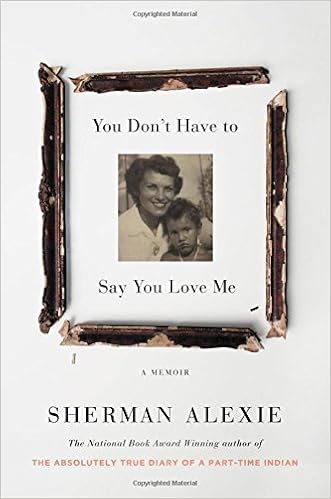
This image is of the front cover of Sherman’s book from amazon.com.
Sherman’s most recent piece of writing is entitled You Don’t Have to Say You Love Me, it is a personal memoir that follows Sherman’s relationship with his deceased mother. In an interview on Npr.org Sherman talks with the host David Greene about his memoir. It turns out that Sherman’s dad was an alcoholic so his mother took care of the family by making a selling quilts. But Sherman’s mother was not loving, according to Sherman his mother still scares him and “haunts” him from beyond the grave. “Because I'm bipolar, because I'm obsessive compulsive, because I'm an alphabet soup of mental illness acronyms, I see things. I see ghosts.” Sherman goes on to say that if he could ask his mom one question it would be “was there ever a moment in your life where you felt powerful.”Alexie goes onto further elaborating saying that women are extremely “vulnerable people in terms of domestic violence.” He goes on to further state that his mother was a victim of such abuse: “And my mother was not spared from feeling that powerless against the world - not only against whiteness and colonialism, but against some of the villains inside our own tribe.” This powerlessness that Sherman describes is felt by many Native American women as there is a high rate of abuse on reservations. Sherman even states that if he went back in time and was his mother’s partner he would “adore” her stating that “I don’t know that she was ever adored.” And Sherman ends the interview with a heartfelt statement, “Because the thing is, regardless of how bad a mother she could be, at some point in my adulthood, I actively became a bad son.” This memoir, a factual account of Sherman’s life, effectively encompasses the literary well of his childhood that drives Sherman’s writing.


Comments
Post a Comment